
Federalist 2.0TM
Healing the political divide by building a Citizens Political Professional Organization (CPPO) & learning how to govern for all.


Mission
Provide the most comprehensive and effective systems that drives the minds of citizens to rightful thinking to “Save America” and ensure freedom and liberty for all. By providing key financial mechanisms and systems to help drive right-minded change.
Vision
Our vision of the future is for all Citizens of the United States and of the World to know and understand what good governance means to “Save” their countries. Additionally to show the result of bad governance, while developing systems to achieve the good.
Problem
For centuries, the human condition has been one plagued with war and disease, but during the American Revolution in the 1700s a miracle happened, a group of people were set free, and an institution was built to guarantee those Freedoms. What was the magic that was unleashed, and how can we rediscover that mechanism and codify it for the future? The Federalist 2.0 philosophy addresses this question.
Today, in our current world there are two problems that need to be addressed, the first is Election Rigging and the second, given that election rigging is possible, the attack and use of the US Federal Financial Power. The following are a three (3) part series that addresses this issue...
-
Part 1: Election Rigging
-
Part 2: Stealing the Bank
-
Part 3: Defending the Solution (Working).
PART 1: Election Rigging
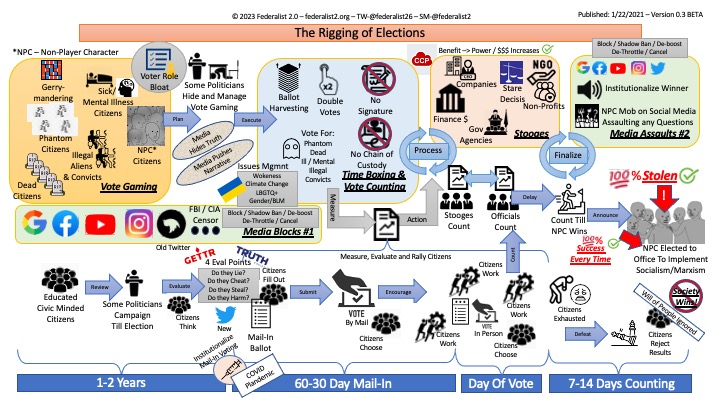
The United States election system is not functioning as expected, from a federalist point of view this is what we have today:
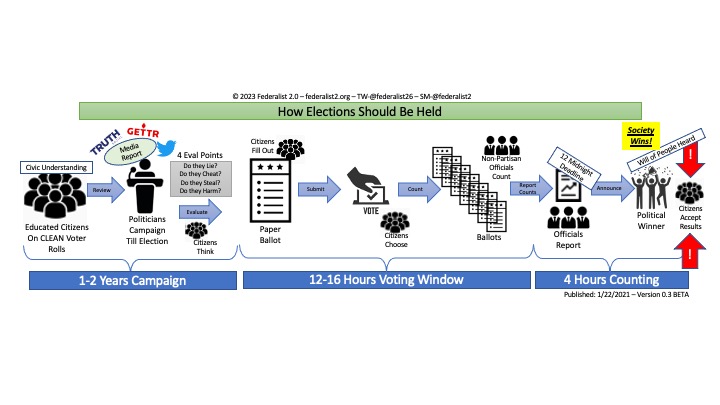
Where the process SHOULD look like the following:
PART 2: Stealing the Bank
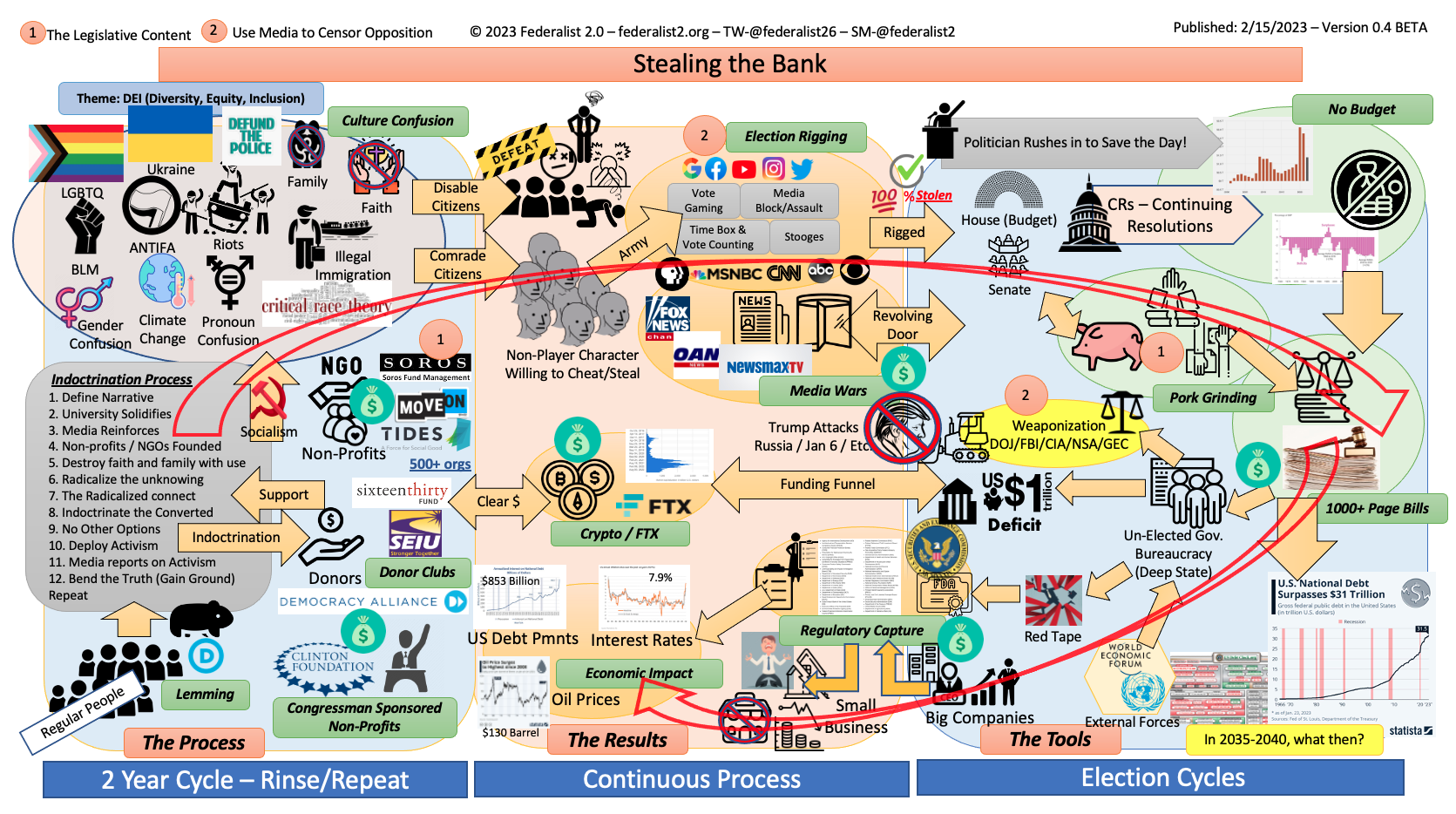
This level of rigging then leads to the following systematic process that allows groups of people to engineer the "Steal" of the US Financial Resources for their own benefit:
Part 2d: 12 Step Program - Solution
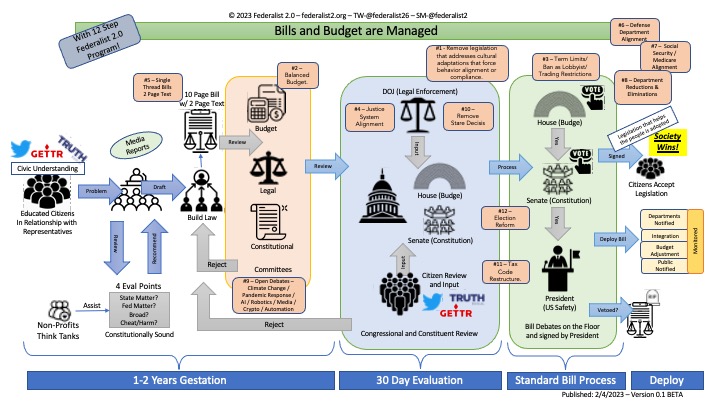
The following is the clean process and the 12 Step Program that would properly align from the process above work:
The final Part 3 addresses how systems can be setup to defend the solution, how can we align the Purpose of Politics to as close to the Intent of Politics as possible.
Part 3: Defending the Solution - The Plan
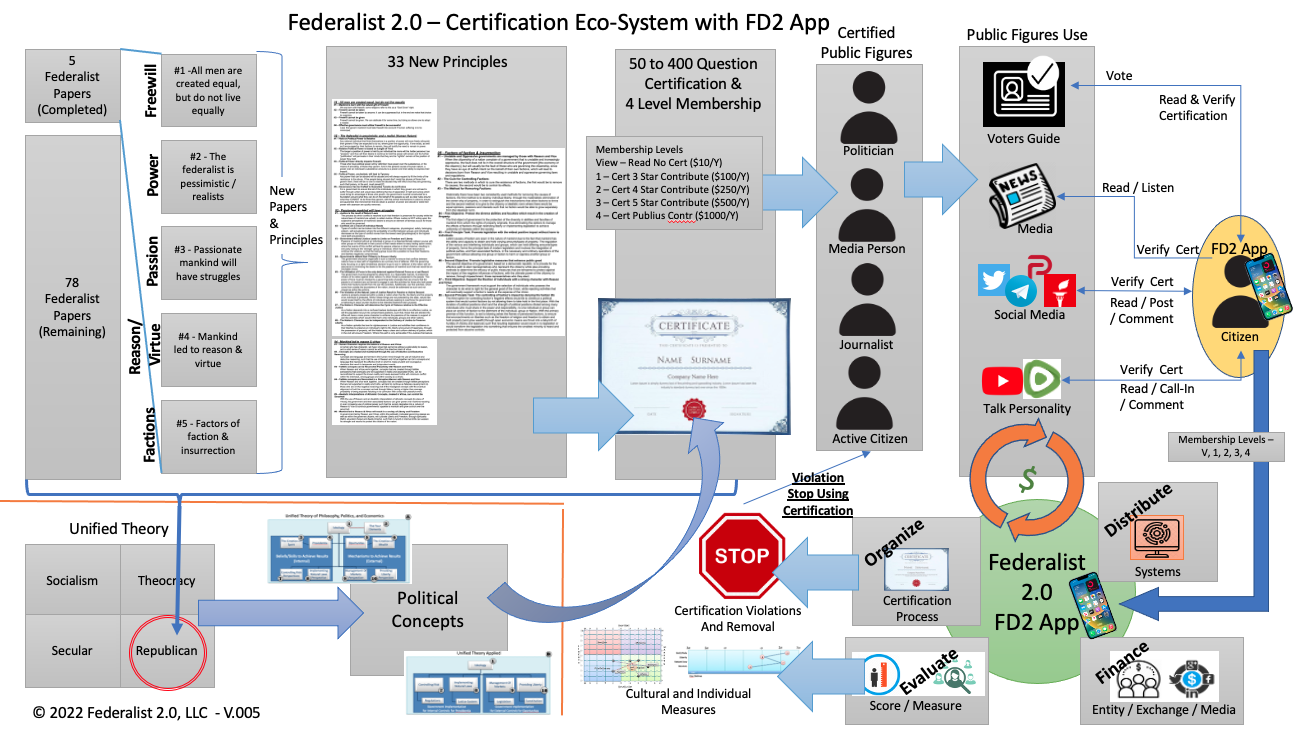
The Federalist 2.0 is an attempt to integrate a proven morally and spiritually consistent philosophy, advanced proven technology and advanced financial instruments to solve this problem. With a defined organization and marketing approach by addressing specific markets with business models, this dream can become a reality.
Federalist 2.0 is developing an Eco-System with an FD2 Application that will support this philosophy, this is an overall thumbnail as to how the Eco System with the application would work. The details of the Application can be seen here in the plan.
The solution will have the following 3 Benefits:
-
Creation of a new revenue/opinion generation model
-
Shift Opinion to remove the drive to use government revenue or impose rules / regulations
-
Methods and tools to monetize brands and political candidates/positions (New Brand Monetization Tool)
The five capabilities that we will bring include:
-
Reward Picker (New Micro-Donations Tool)
-
District Self Serve Voting Recommendations Tool
-
Accountability Tools for In Office Politicians
-
Contributors are Rewarded for their efforts
-
Automated Meeting and Gathering Tools
"It has been frequently remarked, that it seems to have been reserved to the people of this country, by their conduct and example, to decide the important question, whether societies of men are really capable or not, of establishing good government from reflection and choice, or whether they are forever destined to depend, for their political constitutions, on accident and force."
As such from here on out all content published (unless otherwise noted by authors) will be signed as....
.....Publius
Latest posts
-
 From Breitbart to Today's Challenges: Some Ideas from The Past It's September 10, 2025, and the news of Charlie Kirk's assassination has just come out. He was speaking at a university event when it happened. As someone nearing 60, I've followed his work for years, starting from his first article on Breitbart in 2012 about bias in school textbooks. That piece came during a time when I was active in those same online discussions, commenting as Federalist2. Let me share a bit about how those early conversations led to some ideas that might be useful for younger folks today.
 -
 Limited Government vs. Small Government Many people today, especially those on the conservative champion needing “Small Government” - usually as they expand another area. But this thought process misses the entire intention of the Constitution. The Founding Fathers of the United States crafted the Constitution with a clear vision of limited government, outlining enumerated powers to prevent the central authority from becoming too intrusive. This concept of limited government was rooted in the experiences of the American colonies under British rule, where they had grown wary of a distant and overreaching monarchy. The Constitution, ratified in 1788, aimed to establish a federal government with specific listed powers leaving the rest to the states or the people under the Tenth Amendment *(*[*<u style="text-decoration:underline"><span>https://constitution.congress.gov/constitution/amendment-10/</span></u>*](https://constitution.congress.gov/constitution/amendment-10/)[*<u style="text-decoration:underline"><span>)</span></u>*](https://constitution.congress.gov/constitution/amendment-10/)[<u style="text-decoration:underline"><span>[1]</span></u>](https://constitution.congress.gov/constitution/amendment-10/)
 -
 George Washington's Inspirational Covenant George Washington, the revered Founding Father and first President of the United States, is often remembered for his leadership during the American Revolutionary War. However, what is less well-known is the remarkable moment when he was inspired to write a covenant, a solemn promise to his troops and the fledgling nation. In this article, I will discuss the events leading up to the drafting of this covenant, its actual text, and the impact it had on the war and the nation.
 -
 Free Speech vs. Hate Speech Hate speech, a term that has gained significant attention and debate in recent years, is a contentious issue when it comes to defining it and distinguishing it from speech that may be disagreeable, vulgar, or despicable. This article will explore the key differences between what is been labeled “hate speech” and other forms of expression, the challenges in determining what constitutes hate speech, and the various approaches taken to address it.
 -
 The Minutemen and our Second Amendment The American Revolutionary War, which began in 1775 and culminated in the United States gaining independence from British rule in 1783, was a pivotal moment in history. The conflict had profound implications for the American colonies and, indeed, the world. One of the most iconic and vital components of the American Revolution was the Minutemen, a group of volunteer citizen-soldiers who played a crucial role in the early stages of the war. In this article, I will explore the positive reasons for the establishment of the Minutemen (with the best rifle of the day, today it would be classified as an “assault rifle”), the protection they provided their neighbors, family, and country, and draw comparisons between their actions and the idea of arming oneself today for the protection of family and neighbors. I will also discuss the erosion of the Second Amendment and the potential dangers this poses for both individuals and the country. Finally, I will discuss the complex issue of how society should address mentally deranged individuals who buy or steal firearms, and whether the focus should be on them or on the law-abiding citizens.
 -
 Protecting Constitutional Rights The protection of constitutional rights is a cornerstone of American democracy, which is actually a representative republic. These rights, enshrined in the U.S. Constitution, are intended to safeguard individual freedoms and limit government power. Government was never intended to be limited by size; it was limited to certain responsibilities enumerated in the Constitution. One of the Governments primary responsibilities is to protect the rights given to every citizen.
 -
 Standing Up Against Tyrannical Governments: A Moral Imperative Throughout history, individuals and societies have grappled with the moral and ethical dilemma of standing up against tyrannical governments versus kneeling and accepting whatever they demand. This profound question transcends time and borders, challenging our fundamental principles and the very essence of our humanity. While the choice to stand up against tyranny may entail sacrifices, it is a moral imperative rooted in principles of justice, liberty, and human rights.
 -
 Stealing the Bank - The Solution - Part2d We believe. What do you believe? What can one believe? Is it an impending climate change disaster, never ending race wars, never ending wars for that matter, gender dystopia, defunding the police, hordes of illegal immigrants pouring over the border, school curriculum capture, gay rights, Antifa, pronoun language shift, universal everything… what is it you… yes you the reader, what DO you really believe? No need for family, no need to think critically, no need to work, no need to be kind with hate at hand, no need to look into the future, no need for kids, no need to build skills of service and ultimately no need for God…. Humans got this!